Indirect low value spend categories: real life example with tips (office supplies)

Another subject, that I have recently dealt with, was office supplies. One of those categories, which is usually left unnoticed, when things go great; but the moment the tiniest thing changes or is missing (for instance, stapler. Can you imagine, how bad it is to come to an office supplies cupboard, and to find black (!!!) stapler instead of blue! Outrageous!!! I am joking, of course. Or am I?), all the hell brakes lose.

Imagine you have 20 locations across Europe. Do you think that makes you a very attractive customer for stationery supplier? Think more. Let’s say, overall annual spend is €200k (for all of those twenty or twenty-many locations). Do you think it makes it worth a while investing quite expensive purchasing manager’s time to negotiate tiniest price of tiniest item? Think even more. Did you think, that finding biggest spend item and negotiating only the price of that one item will bring your spend down while not investing too much time and resource into managing the category itself? Warmer, but not yet to the point. Think again.

Huge part of indirect, very small and scattered category TCO costs is administration costs. Every PO you raise (and that is also goods reeiving, invoice processing), without going into too many details, can cost your company anywhere from €150 to €250. If the order value is up to 250 Eur – your administration costs are 100% of the value of goods. How much did you say you negotiated off the price? Let’s say, you order stationery once a week. That is, let’s assume, deducting all holidays and human factors, 40 times a year. Say, with average costs of 200 Eur per PO, you will end up facing 8000 Eur of administrative costs per year. And that is – per each location! 160 000 Eur!!! If you still remember, the cost of goods being €200k.

To keep this all post Friday-short and considering the value of it to the company, here is the short list of things to keep in mind, dealing with stationery:

  • Consider alternative options at all: company stops buying stationery at all, sets “stationery supplement” and pays it out to staff for them to manage it according to their own judgement. This is also a very “green” and “lean” alternative. Many times people print even if they do not desperately need only because they can. People tend not to care much about the property that is “not theirs”. You can change it.
  • Item list. Not longer than 100 items. Or shorter, if possible.
  • Demand management – approved standardised items, budgets.
  • Cost optimization: inventory management; minimum order values.
  • Automation: web-shops, punch-out catalogues, invoice flips, direct invoice injection.

Not everything is as straightforward in procurement as you could think. Please, do drop me a line for more specific thoughts, benchmarking clues – will be more than happy to share my insights – with no charges involved.


Indirect low value spend categories: real life example with tips (office supplies)

Negotiations tip: what is the real bottom line value of a piece of equipment?

This comes from a very recent experience. We all do (fingers crossed) proper homework when buying an expensive piece of equipment. However, sometimes, since it usually is a very ad-hoc unit, finding reference points is difficult.

What I have learnt recently – the supplier himself can be a very good reference point. Very short and simple tip: while negotiating, discuss a “buy-back” price. Ask them: if the product is not successful in the market and we would need to sell the kit, would you be interested in buying it back? For how much? Their answer is your benchmark. Everything else – “expected monetary value” – is a profit that a business could have if they would use the piece of equipment and all other supply chain parts would work well (incoming goods, operations, sales).

Hope you can use this! This definitely goes on my future question list for Capex negotiations.

Negotiations tip: what is the real bottom line value of a piece of equipment?

Buying “like for like”. A man in a beauty store

img_3294

Not the easiest task ever. Not for everyone. And still, very often procurement people face the task of “buying like for like”: according to the sample, according to the picture. This weekend reminded me of that.

Imagine a small company – family. Imagine a very demanding operations department (woman). Imagine a man, representing procurement department. And a requisition to buy “like for like”, with a sample provided. Let me tell you again, it is not an easy task. Not always. Especially, when it comes to a (typical) man, buying cosmetics (come on, Ricardo, you didn’t really expect me not to write about this, did you???).

It’s lazy Saturday morning and I realise, that I cannot leave home (I mean, I can’t really even leave the bed), because I ran out of eye liner. You know, ladies, one of those days – when any excuse to stay in bed is good. And running out of eye liner is something of a size of snow in the middle of August in Lisbon. Anyway, my partner agreed to stop by at Boots on his way that morning. To be safe, I handed in a sample of exactly what I wanted. There is nothing, that can go wrong, you think? Oh well, think again.

The sample was black tiny bottle of a specific brand, specific color, specific functionality (waterproof) eye liner. The bottle was black. My partner came home two hours later, with a big smile on his face, handing back a golden color (!!!), same manufacturer, completely not waterproof eye liner… There I was – standing silently, looking at a completely wrong (in my opinion) bottle, completely happy partner’s face and trying to understand, what and why went wrong. Now it seems funny – I simply did not explain, what is the most important. Also, did not think about how really hard he would want to help me in such a disastrous (running out of eye liner!!! OMG!!!) situation. It turns out – the shop ran out of the item, and the shop assistant offered “closest match”. I bet you get loads of that from your suppliers?!

It was not funny at the beginning. But then I thought of all of the moments, when MY technical department stakeholders were looking at me silently – like I was, just a moment before. Yup, buying “like for like” is not easy. Needless to say, I did not mention the liner again…

Easy morning to everyone! Thanks for reading!

Buying “like for like”. A man in a beauty store

Toilet Paper Test. With results

toilet paper

Albert Einstein once said: “if you cannot explain it simply, you don’t understand it well enough”. And I so much believe it! Life is simple, procurement is simple – unless people ruin it by bringing in all that unnecessary complexity… I will keep this post short and simple too for few reasons:

  1. It is simple.
  2. I did not like the results of my experiment (yup, it is always easier to write about “revelations”, “scandals”, “NEWS!!!” – especially in a bad context. And this time it is not the case. Well, not entirely.).

I have to admit I have a professional disease. I like to know, how efficiently organizations are managing their spend. Especially public ones. And it is definitely not something they are willing to share openly with anyone that opens reception door. However, there are signs to look out for, which give insights very quickly and easy. I call it toilet paper test.

So here it goes: every time I go to any public toilet (GP, airport, schools), I check few things: paper dispensers and the paper itself (or, of course, different technologies – air blades). It is very easy to distinguish between cheap simple paper and a very expensive, printed fancy paper. That simple thing can show you, whether or not a school or GP are potentially overspending up to 30% for this category. And, if they are not working on cost reductions (or over-specification elimination) in this category – what makes you think they work better in other areas?

A week ago (OK, a month ago) I was reading a description of difference between good and bad scientist. And one of the points was saying, that good scientists are ready to accept any results of their experiments: despite the anticipations they had. So here it goes…

I have checked ten schools and three GPs. I have the names written down – should anyone would be after details. I was expecting to see that expensive paper everywhere (or at least in most places). And my assumptions were wrong. The results showed, that only two organizations had very expensive backsides. Eight organizations were using “average” products and three of the list were using “lowest specifications” paper. I (we) should be happy! Yay.

However, then I remembered another exercise that I did about uniforms The Emperor’s new clothes. Or what does it take to become efficient in procurement. Does it mean, that when it comes to their own money, people (organizations) are managing it quite properly, but when it becomes an opportunity to make decisions about “someone else’s” money,  all the logic goes away? Once again – universities and experience can give you tools and knowledge. But none of them can give you the right attitude (and the importance of it is shortly covered here: Dark Matter in Procurement?)

Toilet Paper Test. With results

Key Performance Indicators: The Good, The Bad, The Different

KPI

I can even hear you thinking… “Not those! Not again!”… A sensitive subject, when it comes to your OWN performance measurement. Let’s set the rules now: this time we talk about THEM, not US.

According to Investopedia: “Key performance indicators (KPI) are a set of quantifiable measures that a company or industry uses to gauge or compare performance in terms of meeting their strategic and operational goals. KPIs vary between companies and industries, depending on their priorities or performance criteria.” StrategicContact, talking about KPIs of a call centre, say that “it’s not just about productivity any more”.

The most popular KPIs that are traditionally assigned with procurement, are as follows:

  1. Total Cost Savings;
  2. Quality (IF part of OTIF, 6sigma numbers in Defects Per Unit or Defects per X opportunities);
  3. Delivery (OT part of OTIF);
  4. Cost avoidance;
  5. Implemented cost reduction savings (to keep it short, it shows how successful is the project management or budget implementation);
  6. Procurement Cycle Time (time to market, P2P cycle/cost and similar);
  7. Percentage of suppliers accounting for 80% of the spend;
  8. ROI;
  9. Managed spend versus Maverick spend;
  10. Contract compliance.

Different companies might calculate and interpret them differently – it all depends on the overall company’s goals. Some companies measure some additional factors: Inventory KPI’s (turnover ratio), Employee Learning & Growth KPI’s… The most important part is that everyone in the company is aligned and understand what and how and why they measure.

Available primary data quality is also a vital factor, but this post is not about that.

Like StrategicContact, I also think it is not only about productivity, hard cash. Those are very important, no arguing about that. However, they are consequences of the way people work, the behaviour (theirs, not ours, remember?). That is especially important in current business world, where the change is inevitable.

While creating reporting systems for procurement department and / or function, I have additional categorization:

  1. Efficiency (or productivity – everything, that is mentioned above and is relative for the business);
  2. Discipline;
  3. Accuracy.

Discipline part is very important, when you are trying to implement any change. I have heard sayings “no PO – no Pay”, I have implemented supplier communication groups (e-mail distribution groups), which were helping to implement internal policies with help of external influence. Sometimes, this calls for some resistance from other departments, because in some occasions it shifts the problem from procurement to finance… Having proper KPIs and reporting system in place, allows you to keep up with the T part of SMART requirements: timeliness.

Example: let’s say, your database on item level includes information on minimum delivery time. Which means, you know, that from the moment PO is issued to the time items can be delivered, there cannot be less than 10 days (physically impossible). “No PO – no Pay” policy would pick up only the cases where the items arrived, payment term has come to an end and there is no PO on the system even then, many times more than 40 days later. Consequences, that will bring you negative financial impact (wasted working time of finance, procurement department, non-compliance, etc.). What about all of the POs, that were raised any time before the day 10, but after day 0 (when they were supposed to be raised)? You would never pick up those. If the change you are trying to implement says, that you need to raise a PO as an official order to a supplier. Discipline KPI might pick up all POs, where the difference between PO date and “date required” or “delivery date” is shorter, than minimum possible delivery time. It will definitely pick up all POs, which are raised at the time of receiving goods (if you do not yet have policy of not accepting goods, which do not have PO). Overall, you need to be able to get the alerts before non-compliance turns into costs and in such a way, that you would be able to correct the behaviour that causes all the troubles.

Accuracy is something, that should keep your system set up in tact. Take the example above. If you have minimum delivery times set up, but you notice, that recently, quantity of faster deliveries, especially with one supplier, goes up by 50%. That might trigger your attention to the correctness of system set up. It might indicate, that the person, raising the POs, started doing the job worse, that workload suddenly got too big. But it also might mean, that the supplier opened a warehouse closer to the delivery point and always keeps safety stock in place to serve better. That would require updating the buyer’s system data. If that was not done, your accuracy KPIs will immediately show that.

To sum up – if the reporting and KPI system is set up properly, you will be able timely pick up “the different” and, after asking the right people the right questions, you can decide if it is “the good” or “the bad”.

Thank you for reading! Do you do it differently? Please share in the comments below!

Key Performance Indicators: The Good, The Bad, The Different

Rebates 007: A License To Steal???

pocket picking111

I do not like rebates much. If at all.  Having seen the rebate system being so popular among businesses, I started doubting myself. What if it is only me? What if I do not understand something?

I have shortly looked into quite a few articles  on this subject. Outcome Number 1: googling “procurement rebates advantages” (or any similar wording) give you no straightforward benefits of having it.

So what are the occasions, when businesses use rebates? Outcome Number 2:

  • if the quantity to be purchased is not known.
  • if you want to fund purchasing activity – whatever it is: GPO, “non-profit” organization, department – you name it.

How well do you know your company? Is it possible, that your forecast can go so terribly wrong? If it is me negotiating the price, I want best price available at that moment. If the product has to be produced – most of the times it will be cost plus margin pricing model. You can analyse the costs, might define the margin and try to influence them. I do understand price differences due to production run size, production planning flexibility (while everything else stays the same). And here is my question Number 1: can you then please show me a supplier, who will plan a single production run to satisfy your annual quantities? Thought so. That means – volume based rebates loose their sense. Yes, it is important to understand, what makes the deal attractive to the supplier. Time commitments, quantity commitments – but I am talking more about insurance from losses to the suppliers.

Sample. A deal of estimated 3000 t of plastic packaging is on the table. Supplier suggests a price with 3% rebate if 3000 t is reached.

  • Scenario 1: Buyer accepts the offer and signs the deal. The year finishes with a balance of 2900 t. Will the Buyer order additional (not needed at that time) 100 t of packaging just to get the rebate? Will he decide to loose the rebate? Both cases – the loss is biggest to the buying organization. Keep in mind, that, additionally, Supplier was using those 3% of Buying organization’s money as his financial asset.

  • Scenario 2: Buyer asks, WHY is it 3% and HOW will Supplier be able to give that rebate. Supplier explains, that he would need X tons of main raw material and that they would fix prices now for that quantity, because they are expecting price increase. So, if they get Buyer’s commitment to buy all the quantity, they would eliminate the risk of overstocking and would be able to offer a rebate. Buyer then suggests to commit to buy all the quantity, even if it means the contract lasting 13 or 14 months instead of 12, but in return would ask for 3% discount from the very start. Supplier agrees with these conditions and the deal is signed. The year ends with 2900 t being sold. Buyer maintains commitments and finishes buying the quantity in another 6 weeks. No inventory overstocking, no financial loss, no false commitments.

Now the “funding” question. It gets a bit tricky here. It is a question of perception. Why would you refuse to pay for service, that you believe, brings value? Especially, if the price is transparent and fixed? Many times people choose to opt for “free services”. Guess what – there are no free things in business world. Well, fine, almost. It is up to you to choose if you want to know how much you are paying, or would like to convince yourself it is “free”.

Here is a sample. Take any of GPO companies. “Non-profit” GPO companies. They have a limited number of people working to get best deals for their members. They have limited number of categories with limited number of suppliers. They have a budget, that covers their business costs. They are funded by supplier rebates. Let’s say, the rebates for the purchases of the first 50 companies, that signed up for the deals, bring them to break-even point. Additional companies, signing up for the deals, do not bring any additional costs. But surely, they bring profit. Question Number 2: where does that profitable “non-profit” go?

So much for “benefits” and use of rebates. I managed to find, however, negative parts of it:

  • There’s always a risk that the rebates won’t be paid or remembered.
  • There’s a risk that the price will be inflated in order to cover a rebate to be paid later.
  • There is the time value of money. The supplier is using the rebate amount as their own money for a year. Should that not have it’s own interest rate, payable to the Buyer?
  • If the rebates are not distributed to the end users’ cost centres, it can cause friction internally.
  • It encourages wrong behaviour from Buying side – they might end up with overstocking inventory in order not to loose the rebate.
  • It creates commitments to a supplier. Rebates are a tool to influence your future buying decisions. How restricted do you want to be?

Procurement Heads published an article about John Lewis. Speaking to The Daily Telegraph, The Forum of Private Business, called demand for rebates “pocket picking“.  TESCO’s (and other giants’) behaviour is called “bullying”. Why is it still so popular?

Rebates 007: A License To Steal???

Can Procurement Protect From #Liftstonowhere

lift to nowhere

This is a lift. It takes you nowhere. Really – NOWHERE. It does not move at all. It is one of the EU funded projects. I am not discussing ONLY EU funded projects. Nor am I disputing EU as a structure. However, the facts are plain and simple:

  • it happens with public investments;
  • it happens, just the same, with private investments – maybe not at such a scale;
  • it happens globally (see an article about China’s achievements).

Questions, that I have, are mainly about justification, will, rules and attitude. If you have OJEU regulations for public procurement – will they protect you from fraud or worthless, unjustified spend? Bribery is a capital crime in China, which is punished by capital punishment. Does that protect from it happening? If there is a will, there is a way. To do both good and bad things. If a person is indifferent to things he sees happening around (or afraid to speak up – I know, there might be reasons), if we do not change our attitude – procurement efficiency alone, however good it is, will not be enough. What are your thoughts?

Can Procurement Protect From #Liftstonowhere

R.T.F.M. Really. (A team game idea attached)

RTFM

Mondays are hard days already. Some of them should actually be called Monday Concentrates. Especially when things go not the way you expect them to. Even if you had instructions to avoid all the wrong things.

People rarely read instructions. People fill in original files when you ask them not to. Suppliers submit offers via e-mail when you ask them to use systems. People come unprepared to the meetings even if you send out meeting agenda in advance. People arrive at wrong addresses even if you prepare and send out proper instructions where to come. And they should read the instructions when it is appropriate. Sometimes, that could save a lot of hassle.

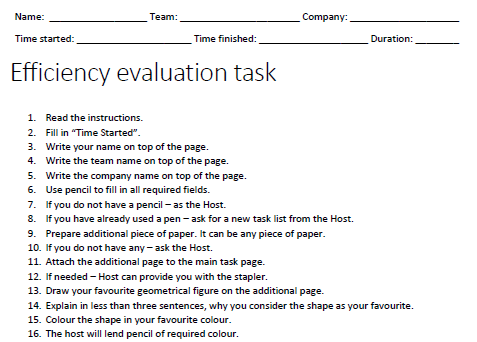
I remembered one small game we were given during one of those no-name trainings. I actually forgot everything about the training, except this game. You can use this game to test your teams’ approach to instructions. You can – if appropriate – test your supplier’s attitude to the rules. That will surely indicate in the future whether or not you should expect the unexpected things. efficiency task list

So here it goes: the host hands out a task list and asks to fill it in. It should be a single page, printed on both sides. It would be advisable for the Host to have all the items, mentioned on the sheet, available at the time of the game. Very simple. 50 questions. The one who does is fastest – wins. Where is the trick? The trick is the first and last questions. The first question says: Read the instructions. The last question says Do nothing and return the page to the host. The person who does exactly that – and reads fastest – wins.

Do not get me wrong – I love inventive, creative people. But there is time and place for everything.

Here is the link to the file for the game: RTFM task

Have fun and please share your feedback afterwards!

R.T.F.M. Really. (A team game idea attached)

So Procurement Is Transparent. And Is That It?

transparency procurement

Hospitality forms. Anti-Bribery acts. Spend policies. Gift policies. Forms and declarations and more reports. Especially popular and famous among people who work in procurement. Has anyone measured, if it works? And if so – how? “Transparency is new green” in procurement, I read. Transparency is a new fashion in strategy. Is that all that it takes to make your business successful?

The Importance Of Attitude

From my own experience – it is more about the intuition and my own attitude. I would never do something to feel committed to a supplier. It does not even matter what it is: asking for tenth set of “free samples”, demanding to take on any sort of unjustified costs… If there is a question on who is paying for the dinner – I would choose not to go at all. One thing is simply being polite and humane. Another – fake political correctness. Imagine a person, who has a will to abuse his/her own company. Do you think hospitality form will stop them? I dare to completely disagree. While if a person is trustworthy – additional forms will only create additional workload and frustration, nothing else.

Is Transparency applicable only to Procurement?

So you have developed five policies, created seven forms for your buyers. Good job! Really well done! I assume, now you feel safe? Think again! It always takes at least two to tango, I bet you heard about that.  I had a dilemma once in my life, while being a commercial director. That is, I was responsible for purchasing and for selling. A prospect customer’s buyer asked for “bonus”. For a commercial director it means guaranteed sales. In big quantities and for quite some time. I went to talk to a commercial director and co-owner of that company. The buyer later on admitted his wrong-doing and was fired; the sales never happened and we lost that client in the long run. Not everyone is like me. What would you do?

Examples from other departments

  • Sales guys issuing fake invoices on the last day of the month and then cancelling them some time into the next month. Nobody likes angry managers at monthly reporting meetings.
  • Managing directors keeping out-of-date and bad quality items in stock, thus trying to keep the value of the inventory – and the company itself, at the same time – way higher than it actually is. Nobody wants to sell a company with a loss (that is, if they would manage to find investors).
  • Retail shops, which from time to time “re-label” the “best before” stickers on some items. Who would want to lose money, right?
  • Road workers, who “save” some tarmac from the roads they are building. And, magically, some newly built private property entrance roads appear next to the main road being fixed. Nobody wants to miss the opportunities.
  • Sales guys, getting “personal incentive” from third parties for reducing the prices lower than company’s official policy.
  • Invisible staff! They are on a budget, on a “head count”, but never appear at work. Rumours – only rumours – sometimes say, they could be close relatives to those who have the hiring decision power.
  • Technical departments, writing product specifications for a single product from a single supplier.
  • Accountancy scandals – which often go very loud. Or people with access to cash money…

I realise, that transparency is important. But it is equally important throughout all departments – not only procurement. Most importantly, a person’s intentions and attitude have to be obvious and appropriate. Then everything else will come as a given.

Thank you for taking the time to read! Please feel free to drop a line with your opinion!

So Procurement Is Transparent. And Is That It?

How Do You Close a Lagoon?

close lagoon

They say – when there’s a will, there’s a way. Do you agree? I think, that even if there is no way at the beginning, but the will is present – you can make the way.

The author of the illustration is Afonso. He is thirteen. We were on a driving and hiking tour one day and it was well into the second half of the day when we approached yet another one of the lagoons to see. After taking five steps towards the road, leading to the lagoon, Afonso stopped and stated, that there is no point to go any further. “Because the lagoon is closed”.

Afonso was a tired teenager. But there and then I remembered tons of tantrums that grown-ups end up having: consciously OR unconsciously. I think the unconscious ones are the ones that keep us from progress. Fear of change, laziness, lack of self-confidence (or, sometimes, over-confidence), lack of trust in other specialists, fear of failure or uncertainty – those are the reasons that stop us all from becoming better, working better, getting better results, to name but a few. Have you heard anything like this?

  • There are no other products (suppliers) like this on the market. Did you do anything to check it? And meant it?
  • We have always done it this way. That one is my favourite. Catherine DeVrye says those are the most expensive seven words in business.
  • Something might go wrong. It won’t work. What if you do nothing? How do you know, that situation, in which you are now, is “right”? And, sometimes, it will go wrong. Sometimes it go wrong many times. Until one day: SURPRISE! – it goes very good!
  • There is not enough time. What about trying to plan?
  • I know best. Yes, of course! Me too! See the guy on the couch? Him too! Also, the lady that just passed by – I bet she knows it best, too! What if we would just make sure, that my “best” matches your “best”? What if we would be open and willing to hear?
  • There is not enough money. Or is it ideas, inventiveness, discipline, will, that is actually missing?
  • We do not have resources / skills. Is it not something you can get – if you really need it?
  • Lagoon is closed. The sign says so – and the sign cannot be wrong, can it?

These and many similar are the things, stopping us from finding another opportunity (to save costs, improve processes, create additional service and/or value to customers). Changing our mindset will open new roads. To see the lagoon, as well.

Another category is the concious ones. To put in simple words – when we lie. With good intentions, with bad intentions. More or less creatively. Many years ago, while still at school, when all the homework was still done with paper and pen, I remember  not bringing mine to the teacher, because “my cat spilled milk accidentally over the notebook”. Unfortunately, the teacher knew my family well enough to know, that we do not have any cats. And then it was too late to change my main character of the story to “my little sister”… Those excuses, however, is a different story. Do you have any of them?

How Do You Close a Lagoon?